
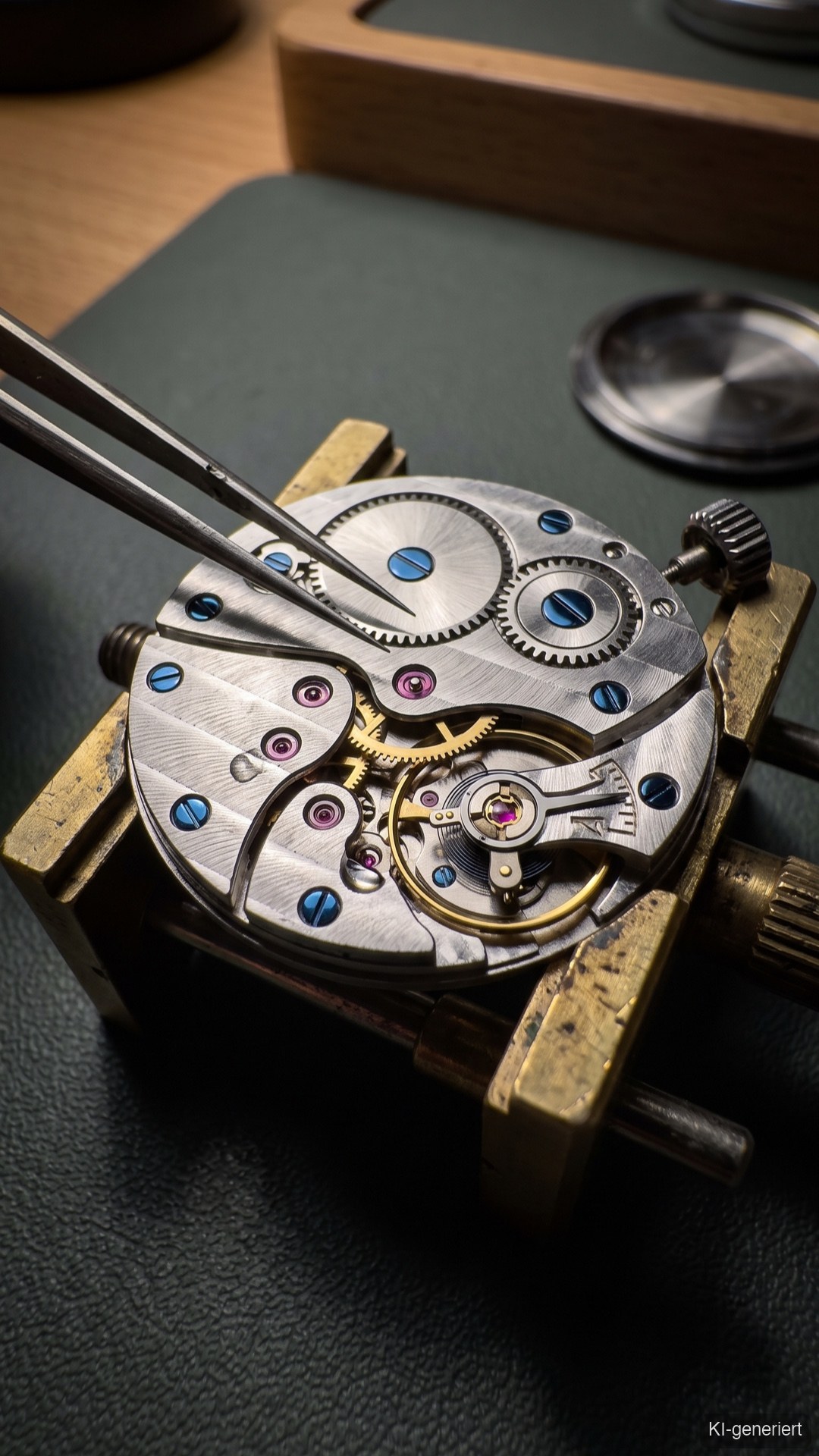
Extreme macro photograph of a mechanical watch movement, commercial advertising campaign quality, vertical 9:16 format, photorealistic, shot on a full-frame camera.

Subject and scale: the exposed movement of a mechanical wristwatch, only 28 millimetres across, clamped in a worn brass movement holder on a watchmaker's bench. Shot very close: the movement fills about four fifths of the frame width and sits in the middle third of the vertical frame. Visible in fine detail: rhodium-plated bridges with tight Geneva stripes, circular graining on the mainplate, deep-blue heat-blued screws with polished domed heads and clean straight slots, ruby jewel bearings sunk in polished countersinks, the gold-toned balance wheel under its balance cock with the coiled hairspring frozen mid-swing and the regulator arm clearly readable, the click and click spring, crown wheel and ratchet wheel with fine sunburst finishing, the wheel train visible through a cut-out in the bridge, one droplet of clear synthetic oil sitting on a jewel.

A pair of slender watchmaker's tweezers enters from the upper left, correctly scaled and delicate: thin tapered steel arms no thicker than a pencil lead, tips hair-fine and needle-sharp, hovering a few millimetres above the balance cock. The tips are critically sharp, the shaft falls out of focus toward the frame edge, and the hard light throws a crisp dark shadow of the tweezers straight across the bridges. No hands, no fingers, no person anywhere in the picture.

Lighting, the most important part: a single hard, unmodified bare light from camera right, low and grazing, only about eight degrees above the surface of the bench, aimed straight across the movement. This is hard light, not soft light. Every shadow has a razor-sharp edge. The right flanks of the bridges, the screw heads and the wheel teeth are brilliantly lit while their left sides drop into deep shadow; the entire left quarter of the frame falls to near-black with no detail. The grazing beam catches the Geneva stripes and the circular graining so they ignite as fine parallel lines of light. Tiny mirror-hard specular points burn on the blued screw heads, the polished countersinks and the tweezer tips. Only one weak silver bounce from the left, just enough to keep the shadow side from going flat. Very high contrast, deep clean blacks, no fill flood, no ambient wash. The lower right corner of the frame stays dark, quiet and free of detail.

Foreground and background: the dark grey-green rubber work mat, scarred with old scalpel cuts and a scatter of fine metal shavings, runs out of focus toward the bottom of the frame and is mostly in shadow. Far behind, blurred beyond recognition, the warm edge of an old beechwood bench and the dark shape of a removed steel case back catch a thin rim of the same hard light.

Optics: 100mm macro lens at f/8, roughly 1:1 magnification, focus stacked so the whole movement is critically sharp while mat and background dissolve, camera 35 degrees above the bench looking down onto the movement, natural lens vignetting, a trace of longitudinal chromatic aberration in the brightest speculars.

Rendering: real steel, real brass, real dust. Fine machining marks, honest micro-scratches and faint tarnish on the tools and the holder, a few motes of dust caught in the beam, cool neutral grade with warm brass and gold accents, high micro-contrast, editorial print quality.

No text, no numbers, no logos, no watermark, no brand names, no dial, no typography anywhere in the frame. No hands, no fingers, no plastic or CGI sheen, no glow effects, no soft studio lighting, no oversized or clumsy tools, no impossible or fantasy gear geometry, no duplicated or floating parts, no oversaturated colours.
Prompt bewerten!
[Gesamt: 0 Durchschnitt: 0]