
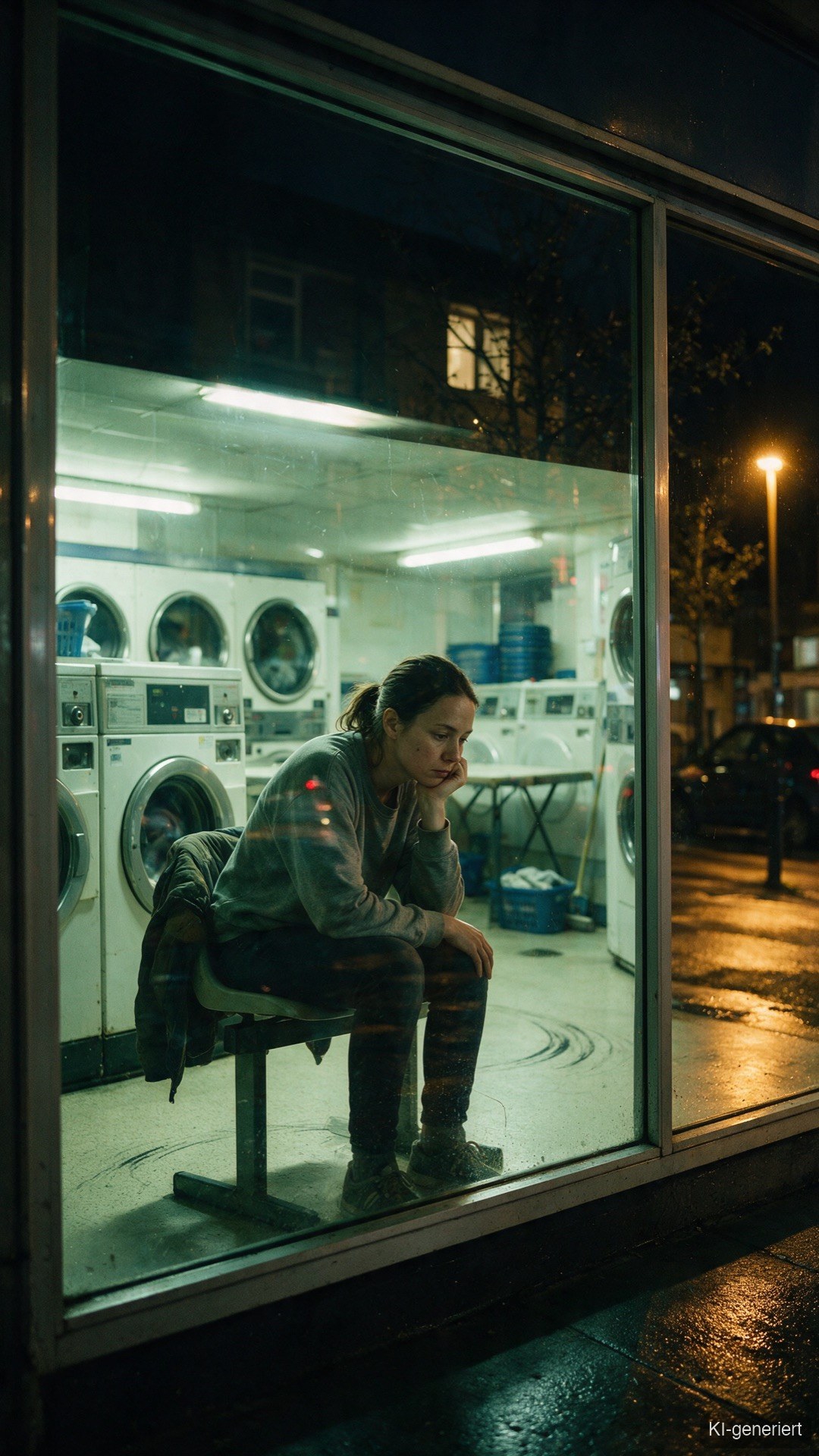
Vertical documentary street photograph taken at night on a city pavement, shot from outside through the plate-glass window of a small self-service launderette, editorial photography quality, 9:16 format, photorealistic, single frame, hand-held on a full-frame camera. Nothing is posed and nobody in the picture knows the camera is there: it is about half past eleven at night and one woman is sitting inside waiting for her washing to finish.

The two layers, which are the whole point of the picture: one sheet of glass carries two pictures at once. Through the glass, the lit interior of the launderette. On the surface of the glass, the dark street behind the photographer, mirrored. Both are present in the same frame at the same time, correctly overlaid, neither one erased by the other. This is a real single-exposure reflection, not a double exposure and not a composite.

The person: a woman in her mid thirties, ordinary and tired, plain northern European face with no makeup, visible pores, faint shadows under the eyes, a small mole on one cheek, dry lips. Dark hair pulled back into a loose low ponytail with strands escaped at the temples. She sits on a moulded plastic chair bolted to a rail, leaning forward with one elbow on her knee and her chin resting in the palm of that hand, the fingers loosely folded against her jaw, exactly five fingers, correctly jointed. Her other hand rests flat on her thigh. She looks sideways and down at the spinning drum, not at the camera, not at anything in particular. Her expression is completely blank and private, the face people wear when they think nobody is looking. She wears a washed-out grey sweatshirt with a stretched neckline, dark jeans, and unlaced trainers; a padded jacket is thrown over the back of the chair.

The interior: two facing rows of white front-loading commercial washing machines with scuffed enamel and dented steel trim, one drum turning behind its round port with a blur of dark fabric inside it, water at the bottom of the glass. A stack of blue plastic laundry baskets, one on the floor half full of folded towels. A scratched laminate folding table. Pale speckled vinyl flooring with black scuff arcs and a floor drain. A mop leaning in the far corner. Everything worn, clean and unstyled; no decoration, no plants, no styling props.

Light, the part that carries the picture: overhead fluorescent tubes inside, cold and slightly green, about 4300 Kelvin, flat and even and coming from straight above. It is the least flattering light there is and exactly the right light here: it puts a small hard highlight on her forehead, on the near cheekbone and along the bridge of her nose, and drops short shadows under her brow, her nose and her lower lip. Her chin and the underside of her jaw are lifted a little by bounce off the pale floor. Outside, one sodium street lamp stands far to camera right at about 2000 Kelvin and lays warm amber across the wet pavement and along the bottom edge of the glass; the spill of cold light from the shop window pools out onto that wet pavement and mixes with it. The two colour temperatures never blend: cold green-white inside, warm amber outside, meeting exactly at the pane.

The reflection, described precisely: on the surface of the glass lie the amber street lamp drawn out into a soft vertical streak, the dark humped shape of a parked car, the bare branches of a small street tree crossing the upper third, one red tail light as a small blurred point, and the faint doubled outline of a lit first-floor window in the building opposite. The reflection is densest along the lower third of the glass, over the machines, and again across the very top; it thins almost to nothing exactly where her head and shoulders are, so her face reads clearly through the pane. That placement is deliberate, the way a photographer moves two steps sideways until the subject's head sits in the dark part of the reflection.

The glass itself: real plate glass, a few old fine scratches, dried rain spots along the bottom edge, one faint smeared handprint low down, a hairline of dust in the corner of the frame, very slight optical distortion where the pane is not perfectly flat, light condensation only in the bottom two corners. The frame of the window is powder-coated aluminium, chipped, with a rubber seal.

Composition: her head, her hand and the lit interior sit in the middle of the frame; the main subject fills the middle two thirds of the vertical frame. The top of the frame holds only the dark blank shopfront fascia above the window and dark reflected night sky, with no important detail. The bottom holds quiet wet pavement with a soft spill of light on it, also with no important detail. The picture reads the same cropped to 9:16 and cropped to 4:5. Works in both 9:16 and 4:5 crops. The lower right corner stays quiet and dark.

Optics: 50mm lens at f/2.0, 1/125 second, ISO 3200, hand-held at standing eye level about 160 centimetres, the camera held exactly square to the pane so the reflection is not keystoned. Focus locked on her near eye through the glass. The reflected layer is rendered a fraction softer than she is, because optically it lies further away, and that small difference is what proves it is a real reflection. Shallow depth of field, the far row of machines falling off into softness, natural corner falloff, mild lens vignetting, honest high-ISO grain in the shadows, a trace of chromatic aberration along the bright lamp streak.

Rendering: real skin with pores and texture, real worn enamel, real scuffed vinyl, real wet asphalt, real glass. Visible sensor noise in the deepest shadows, high micro-contrast, deep clean blacks, natural muted colour, editorial print quality, no HDR flattening.

No text, no letters, no numbers, no price lists, no washing programme labels, no instruction plates on the machines, no coin slot markings, no dials with numbers, no shop name on the window, no posters or flyers taped to the glass, no opening hours, no typography anywhere in the frame. No logos, no brand marks, no watermark. No neon signs, no illuminated advertising, no cyberpunk look, no foreign-language shop signage. No plastic or waxy skin, no beauty retouching, no smoothed pores, no glassy doll eyes, no fashion model face. No extra fingers, no missing fingers, no fused or duplicated fingers, no third hand, no bent or broken wrist, no distorted hand geometry. No second person, no crowd, no pet. No reflection of a photographer, no camera, no tripod, no flash burst in the glass. No smiling at the camera, no posed studio portrait lighting, no backdrop. No CGI sheen, no glow or bloom effects, no added lens flare, no oversaturated orange-and-teal grading, no heavy rain streaks drawn across the frame, no fog machine haze, no cartoon or illustration style, no letterbox bars.
Prompt bewerten!
[Gesamt: 0 Durchschnitt: 0]